


Imposter Syndrome

When knowing you are capable doesn't stop you feeling like a fraud.
Imposter syndrome can be particularly frustrating for experienced professionals.
You may have considerable evidence of your competence. You may understand intellectually that you have earned your position. Other people may trust your judgement and regard you as highly capable.
Yet, in certain situations, something quite different happens internally.
You doubt your judgement. You compare yourself with others. You worry about being exposed as less capable than people believe. You overprepare, seek reassurance, avoid visibility or feel an ongoing need to prove yourself.
This is one of the reasons insight alone doesn't always resolve imposter syndrome.
Why does imposter syndrome persist?
Sometimes the reaction being triggered in the present has its roots in experiences from much earlier in life or in your career.
Experiences of criticism, humiliation, exclusion, comparison, failure or feeling that acceptance depended upon achievement can contribute to deeply learned beliefs such as:
I'm not good enough.
I don't belong here.
Other people know better than me.
I have to prove myself.
I can't make mistakes.
I can't trust my judgement.
These beliefs can continue to be activated even when your current circumstances provide considerable evidence that they are no longer accurate.
This helps explain an experience I frequently encounter with high-performing professionals: knowing rationally that you are competent yet consistently feeling competent.
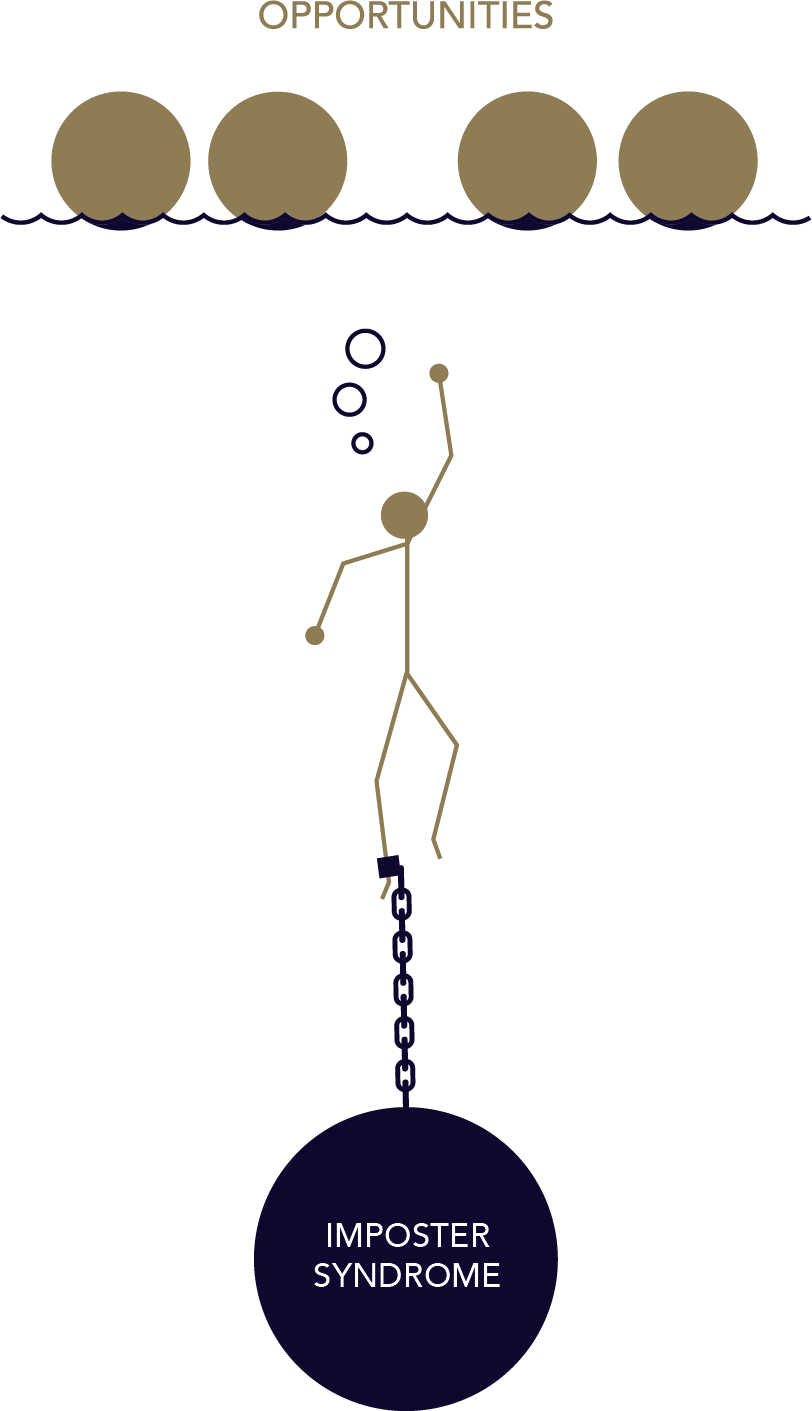
How EMDR can help.
Eye Movement Desensitisation and Reprocessing (EMDR) is a psychological therapy originally developed for processing traumatic experiences. It is now used more broadly where past experiences continue to influence emotional and behavioural responses in the present.
Rather than simply challenging the thought “I'm an imposter”, EMDR can help identify and process the experiences and associations that give the belief its emotional power.
We may explore when you experience imposter feelings most strongly, the thoughts and physical sensations that accompany them, and whether the same feeling connects with earlier experiences.
EMDR can then be used to work across three areas:
Past experiences
Processing experiences that may have contributed to beliefs about competence, belonging, achievement or self-worth.
Present triggers
Working with situations that continue to activate the response, such as being challenged, presenting to senior colleagues, receiving criticism, making important decisions or stepping into greater visibility.
Future situations
Rehearsing future challenges while strengthening more adaptive beliefs and responses.
Why knowing you’re capable doesn’t always make you feel capable.
In this episode of Non-Billable, I explore why imposter syndrome can persist even when there is considerable evidence of competence and why trying to think your way out of it is not always enough.
From proving yourself to trusting your expertise.
The aim is not to eliminate uncertainty or create unrealistic confidence.
Experienced professionals will sometimes be uncertain. They will sometimes make mistakes. They will encounter people who know more than they do.
The aim of EMDR is not to create unrealistic confidence or remove healthy self-questioning. It is to reduce the emotional intensity of the imposter response so that uncertainty no longer automatically becomes evidence of inadequacy.
The aim is to develop a more secure internal position from which you can:
Trust your judgement without needing constant reassurance.
Feel that you belong without continually having to prove it.
Recognise that you don't need to know everything to be credible.
Be challenged without immediately doubting your expertise.
Allow your experience and expertise to be something you can rely upon and trust.
The goal is not greater certainty. It is greater security in your expertise when certainty isn't immediately available! This is a necessary professional skill in today’s changing world.
Different ways of working with imposter syndrome.
Depending on what is driving the imposter response and what you want to achieve, there are three ways we can work together:
EMDR only
Targeting the underlying experiences, beliefs and emotional responses that may be maintaining imposter syndrome.
This is typically 5 sessions.
Executive coaching
Focusing on how imposter syndrome is affecting the way you operate professionally and developing more effective strategies for confidence, visibility, authority and performance.
For this, I recommend 10 executive coaching sessions.
EMDR combined with executive coaching
Addressing the underlying source of the imposter response while also developing how you want to think, behave and perform differently in your professional life.
For this, I recommend 10 executive coaching sessions.
The most appropriate approach can be discussed during an initial assessment.
